Type: Opinion Authors: Kevin Owocki Source: Farcaster
The Problem with Nation-States
The nation-state is an awkward container for solving ecological and economic problems. Watersheds do not respect borders. Food systems do not care about political ideology. Climate impacts do not stop at customs checkpoints. Increasingly, the most meaningful unit of coordination is not the country, but the bioregion.
A bioregion is a geographic area defined by natural characteristics rather than political ones. It is shaped by watersheds, climate, soil, flora, fauna, and the human cultures that co-evolved with those constraints. The Colorado River Basin. The Great Lakes. The Pacific Northwest. These are bioregions. They are real in a way that lines on a map are not.
Bioregions create shared fate. People upstream and downstream are connected whether they acknowledge it or not. This shared fate creates the conditions for shared stewardship and shared investment.
Bioregional Financing Facilities
To act on that shared fate, bioregions need capital.
A bioregional financing facility is a capital allocation system designed to invest in the long-term vitality of a specific bioregion. It can take many forms: community funds, public-benefit investment vehicles, cooperative treasuries, onchain capital pools, or blended finance structures. Its purpose is simple — allocate capital in ways that increase the health, resilience, and prosperity of the bioregion and its people.
Instead of capital flowing extractively to distant shareholders, it circulates locally. It funds watershed restoration, local energy, regenerative agriculture, housing, public goods, and local enterprises. Returns are measured not only in financial yield, but in ecological health, social cohesion, and long-term resilience.
From Capital to Coordination
But capital alone is not enough. The next evolution is coordination.
We are entering an era where AI swarms can help sense, analyze, and coordinate activity across a bioregion. Networks of human and machine agents can monitor ecological signals, surface opportunities, simulate outcomes, and help communities make better allocation decisions. Not as centralized planners, but as distributed intelligence. Decision support for the commons.
The Knowledge Commons
Alongside capital and coordination sits the knowledge commons. Open, shared repositories of local knowledge: soil data, water flows, energy production, governance experiments, investment outcomes. Collective memory that compounds over time. Owned by no one. Used by everyone.
The Convergence
When these pieces come together, something new becomes possible:
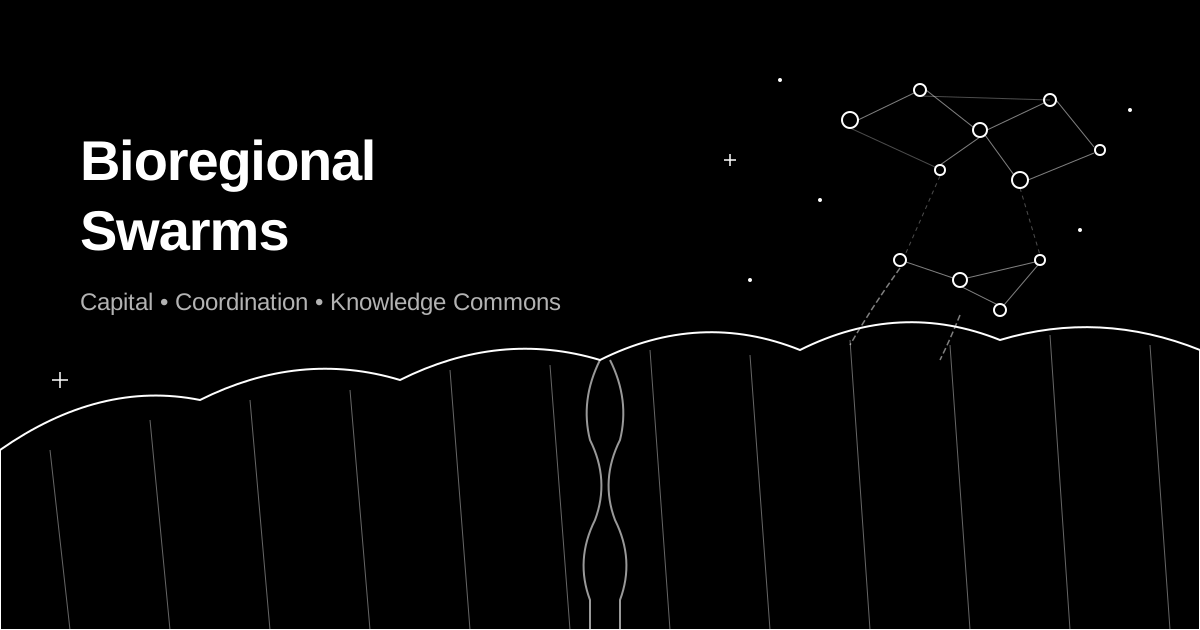
- Bioregional capital allocation — guided by local values
- AI swarms — amplifying collective intelligence
- Knowledge commons — preserving and compounding shared learning
All rooted in place. Bottoms up. By and for the people who live there.
This is the promise of bioregional swarms.